
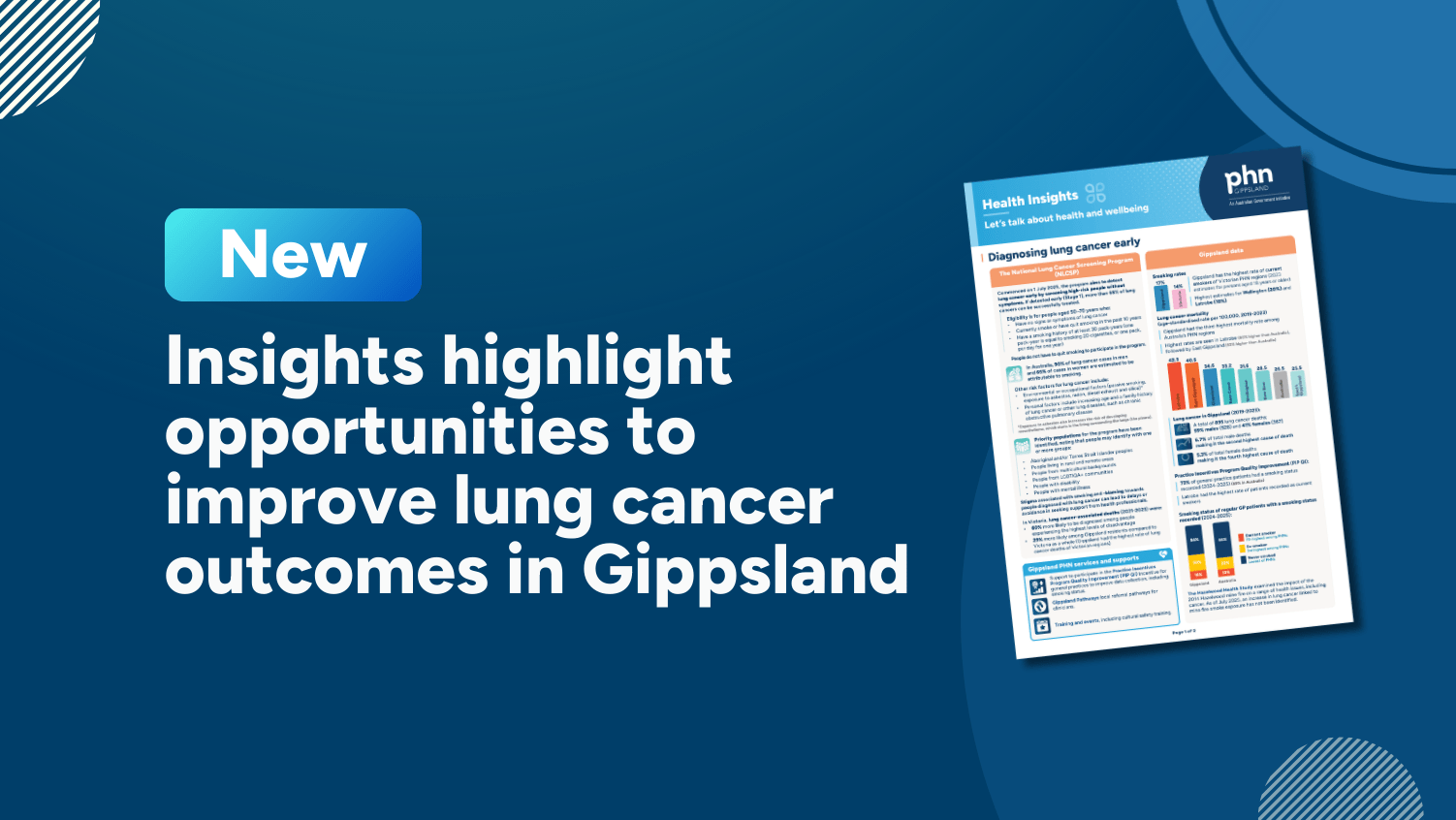
Gippsland PHN has released its latest Health Insights Paper – Diagnosing Lung Cancer Early, offering a unique regional perspective into this serious and often aggressive form of cancer.
The paper provides a snapshot of Gippsland-specific lung cancer health data, statistical insights and important local viewpoints, highlighting the challenges and barriers faced by individuals in our community when it comes to seeking diagnosis and treatment.
Key insights
- Between 2019–2023, Gippsland had the third-highest lung cancer mortality rate among Australia’s PHN regions, with the highest rates seen in Latrobe (60% higher than the rest of Australia), followed by East Gippsland (53% higher)
- Gippsland has the highest rate of current smokers of all Victorian PHN regions, with 17% of the population identifying as a smoker, compared to an average of 14% throughout the rest of Victoria
- Between 2021–2023, lung cancer-associated deaths were 29% more likely among Gippsland residents, compared to the rest of Victoria
- In Australia, 90% of lung cancer cases in men and 65% of cases in women are estimated to be attributable to smoking
- Consultation undertaken by Gippsland PHN revealed smokers were not always aware of screening and support services available to them, adding to treatment participation barriers in the region
- Many people cannot afford to access health care for treatment and diagnosis due to increasing gap fees for primary care, specialist appointments and diagnostic services
The opportunity
While Gippsland has one of the highest rates of lung cancer-associated deaths in the nation, the stigma associated with smoking and blame towards people diagnosed with the disease can lead to delays or avoidance in seeking support from health professionals.
In Australia, 90% of lung cancer cases in men and 65% of cases in women are estimated to be attributable to smoking, however, consultation undertaken by Gippsland PHN revealed smokers were not always aware of screening and cessation support services available to them, adding to treatment participation barriers in the region.
Importantly, more than 65% of lung cancers can be successfully treated when detected early (Stage 1), highlighting the critical importance of early detection and screening in improving survival outcomes.
National Lung Cancer Screening Program
The National Lung Cancer Screening Program (NLCSP), which commenced on 1 July 2025, is a national screening program using low-dose CT scans to detect lung cancer early in high-risk people without symptoms. The program aims to reduce lung cancer mortality by identifying cancer at an earlier stage, when treatment is more effective and survival outcomes are significantly improved.
Who is eligible?
People aged 50–70 years who:
- Have no signs or symptoms of lung cancer
- Currently smoke or have quit within the past 10 years
- Have a smoking history of at least 30 pack-years (e.g. one pack per day for 30 years, or equivalent)
People do not have to quit smoking to participate in the program.
How do eligible patients access screening?
- Speak with their GP, specialist or nurse practitioner
- Be assessed for eligibility
- Receive a referral for a low-dose CT scan
What does it cost?
Mandatory bulk-billed Medicare Benefits Schedule (MBS) items apply to eligible low-dose CT scans, meaning there are no gap fees for patients.
More Information and resources
General public
- Visit the National Lung Cancer Screening Program website to learn more about eligibility, what to expect during screening, how low-dose CT scans work, and access patient-friendly resources and translated materials.
- Speak with your doctor or healthcare provider
Health professionals
- Visit the National Lung Cancer Screening Program webpage for detailed program guidelines, eligibility criteria, referral pathways, clinical resources, and access to the healthcare provider toolkit.
Supporting improved outcomes
Gippsland PHN is supporting improved lung cancer outcomes through:
- Promotion of the National Lung Cancer Screening Program
- Support for general practices participating in the Practice Incentives Program Quality Improvement Incentive
- Strengthening region-specific and referral pathways through Gippsland Pathways
- Education, quality improvement initiatives and training and events across the primary care sector
This paper highlights opportunities for Gippsland’s primary healthcare workforce to identify people at risk of lung cancer and connect them with screening services and cessation support to support prevention, earlier diagnosis and improved treatment outcomes across our region.
Access the full Health Insights Paper – Diagnosing Lung Cancer Early, and other Gippsland PHN publications, here.